
Antibodies are essential mediators of the adaptive immune response, combining antigen-specific pathogen recognition with the capacity to engage immune effector mechanisms. Their variable regions determine binding specificity, while the fragment crystallizable (Fc) dictates downstream effector functions. Among antibody classes, IgG is the predominant isotype in serum and exists as four subclasses (IgG1-4), each differing in their capacity to trigger effector pathways.
In most viral infections and vaccinations, antibody responses are dominated by the proinflammatory subclasses IgG1 and IgG3, which are potent mediators of Fc-dependent effector functions through engagement of Fcγ receptors (FcγRs). However, a notable deviation emerged following repeated administration of SARS-CoV-2 mRNA vaccines: spike protein-specific IgG2 and IgG4 were detected. As these subclasses have limited ability to activate FcγR-mediated functions, this finding raises important questions about how altered IgG subclass distributions influence antiviral immunity, and ultimately disease progression.
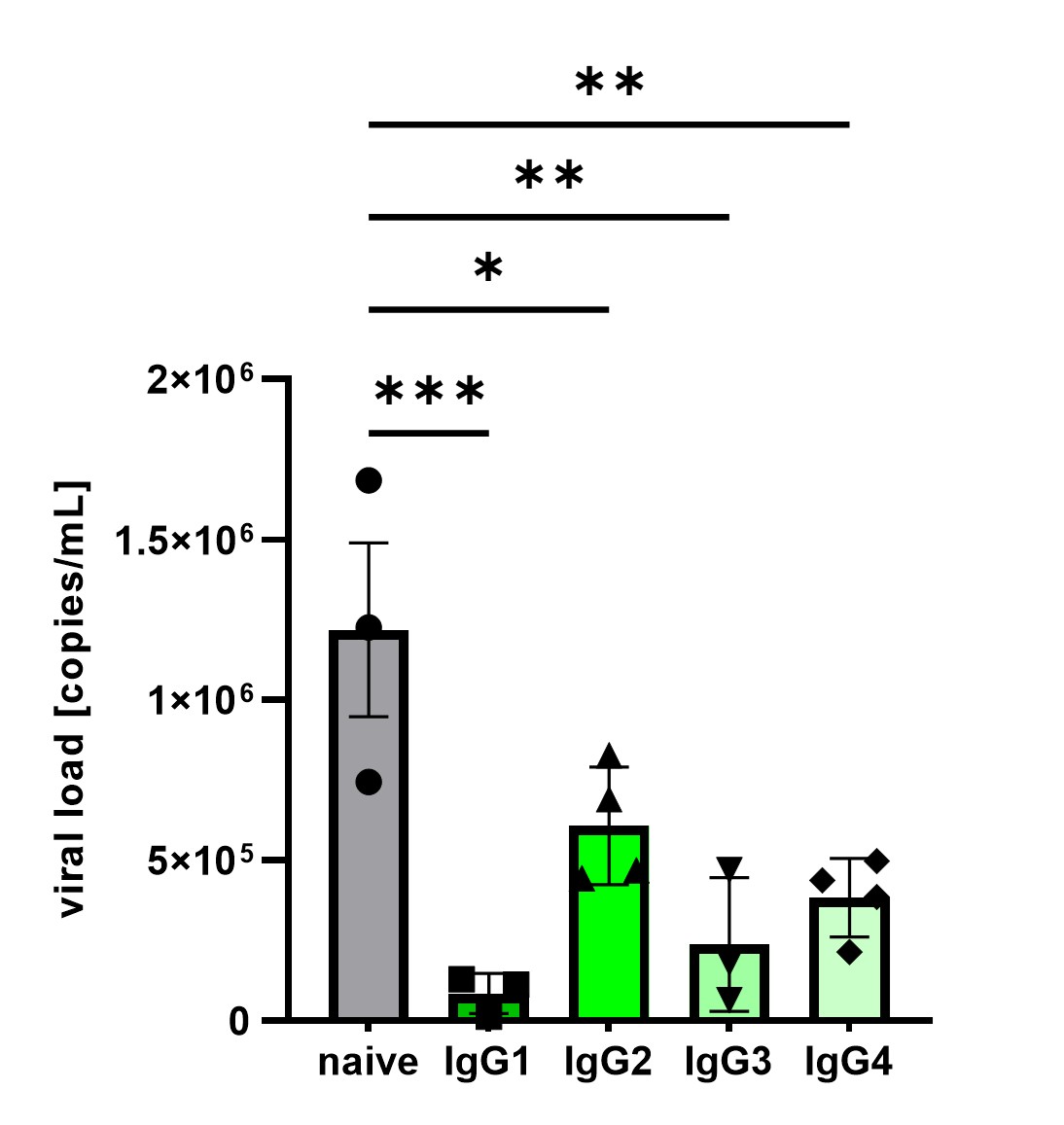
This project investigates how IgG subclass differences influence antiviral immunity independently of antigen binding. To achieve this, antibodies with identical variable regions are produced in different IgG subclasses and characterized in their ability to engage in Fc-dependent effector functions. Using FcγR-humanized mice, we aim to dissect how subclass-specific interactions influence protection against and pathogenicity of virus infections in vivo. Initial experiments have validated this model and provided insight into the role of IgG subclasses in SARS-CoV-2 pathogenesis. This project will further investigate SARS-CoV-2 and extend to influenza A virus (IAV) and respiratory syncytial virus (RSV). As mRNA vaccine platforms are increasingly adapted to these viruses, it will be important to determine the role of these understudied IgG subclasses in antiviral immunity across these infections.